Build Complete Applications from Generative Domain Languages
Six specialized languages for every layer of your stack. Define requirements, APIs, data models, UIs, infrastructure, and architecture with domain precision—then generate production-ready code for any platform or framework.Define once. Generate everywhere. Type-safe across all layers.Built for AI-first development. Read about the journey in our Software Factory blog series.
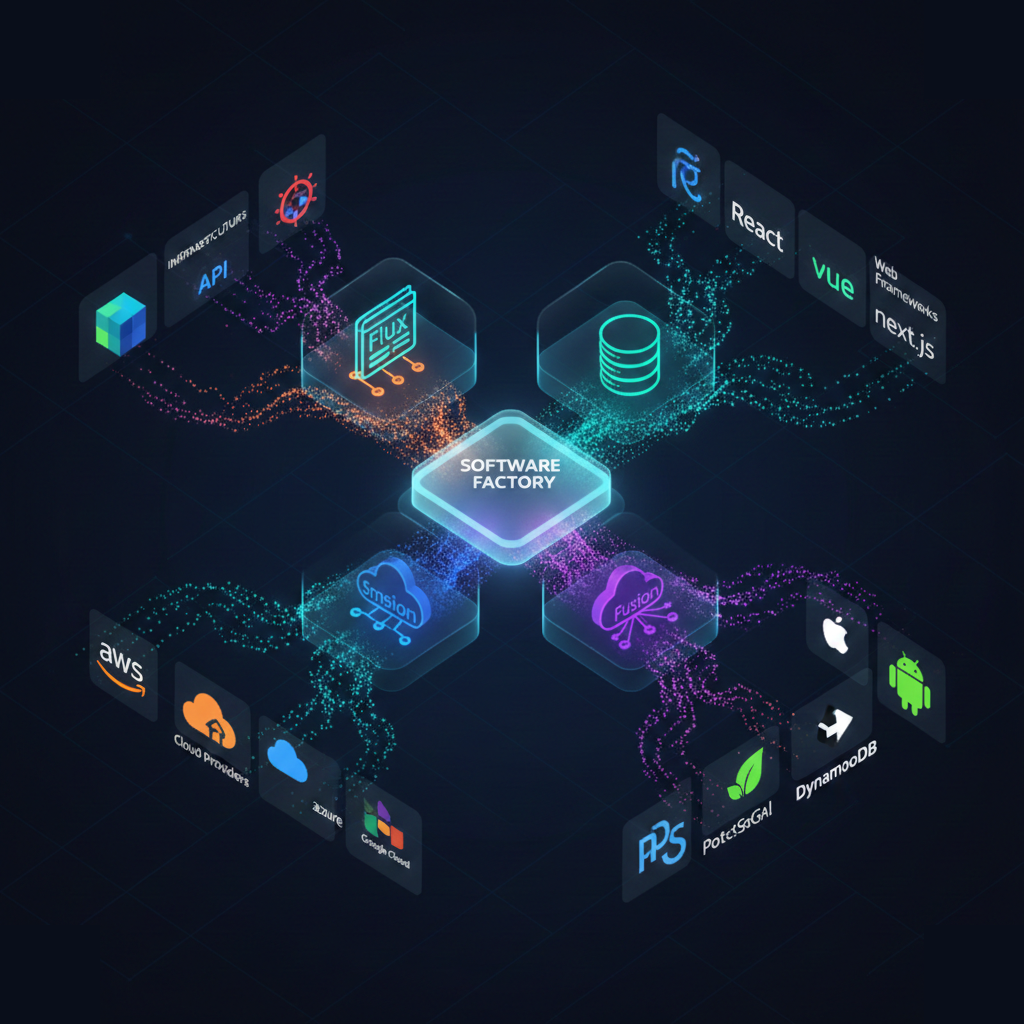
Six Generative Domain Languages
Define your entire stack once. Generate everywhere.
Chronos
Requirements & Behavioral Specifications
Machine-executable requirements language. Define journeys, actors, and outcomes once—generate Jira tickets, Gherkin tests, OpenTelemetry schemas, and state diagrams.
Learn MoreFlux
User Interface Layer
AI-first UI modeling language. Generate native components for React, Vue, SwiftUI, Jetpack Compose, and more from a single definition.
Learn MoreCapacitor
Data Persistence Layer
Database-agnostic schemas that time-travel. Generate DDL, migrations, and type-safe clients for SQL or NoSQL databases.
Learn MoreFusion
Infrastructure Layer
AI-first infrastructure-as-code language. Generate Terraform, CloudFormation, Helm charts, and CI/CD pipelines from a single definition.
Learn MoreSmithy
API Definition Layer
Protocol-agnostic service definitions. Generate server stubs, client libraries, and API documentation for REST, GraphQL, or gRPC.
Visit Smithy.ioLikeC4
Architecture as Code Layer
Define your system topology, service boundaries, and relationships in a clean DSL. Generate interactive diagrams, embeddable React components, and an MCP server for AI agent queries.
Visit LikeC4.devHow It Works
The hybrid approach: deterministic generators + creative AI
Define
Write your requirements in Chronos, API contracts in Smithy, data models in Capacitor, UI components in Flux, and infrastructure in Fusion. These universal definitions are your source of truth.
Generate
Deterministic code generators create all the boilerplate: server stubs, database schemas, type-safe clients, and framework-native UI components. Zero tokens. Perfect consistency.
Implement
Write only your business logic. LLMs or developers implement the creative parts that make your application unique, using type-safe generated code as scaffolding.
The Results
Real impact from the hybrid approach
Consistency
All services share identical structure, serialization, and patterns because they're generated from the same tools
Cost Reduction
Token costs plummet when LLMs only generate business logic, not thousands of lines of boilerplate
Faster Development
From definition to working code in seconds. Build a full-stack MVP during a movie
Real-World Story
Built a fully functional, tested, and bug-fixed MVP in 2.5 hours while watching a movie. Total token cost: $40.
Read the full storyProduction-Ready Projects
Start building with Capacitor, Flux, and Fusion today
Flux
Universal UI Modeling Language. Define your interfaces once and generate native implementations for React, Vue, SwiftUI, Jetpack Compose, and more.
Capacitor
Universal Data Modeling Language. Define your database schemas once and generate native implementations for PostgreSQL, MySQL, MongoDB, DynamoDB, and more.
Fusion
Universal Infrastructure-as-Code Language. Define your infrastructure once and generate Terraform, CloudFormation, Helm charts, and CI/CD pipelines.
Read the Story
Follow the journey from frustration with all-LLM codebases to building a complete software factory
The Software Factory Series
A 6-part series documenting the evolution from expensive, inconsistent AI-generated code to a hybrid approach that combines deterministic generators with creative LLMs.
- From no-code promises to production reality
- The generator epiphany and hybrid workflow
- Building an MVP while watching a movie