Part 5 of 5 in The Software City
Talking to the City
The Final Step: From Navigation to Conversation
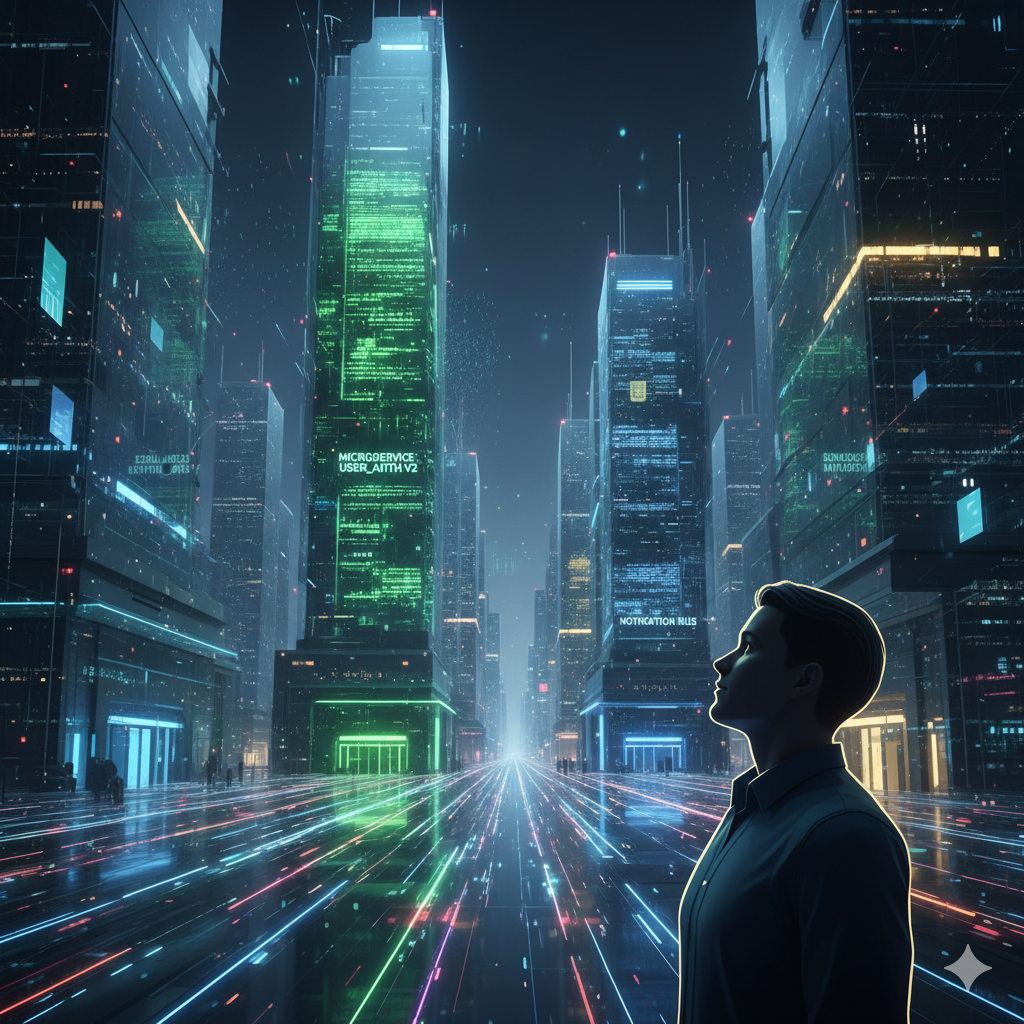
Throughout this series, we've journeyed from the flat world of diagrams to a living, explorable Software City. We've seen it from the architect's sky-high view and the engineer's life on the streets. But the ultimate power of this model is realized when we no longer have to search for answers visually. The final step is to simply ask.
What if the city had a guide? An AI-powered concierge that understands the language of the city and can translate your natural language questions into deep, contextual insights. This isn't just about data retrieval; it's about having a conversation with your system.
One Interface, Many Languages
Different roles have different questions, but they can all talk to the same city. The conversational interface becomes the great equalizer, providing the right level of abstraction for each person.
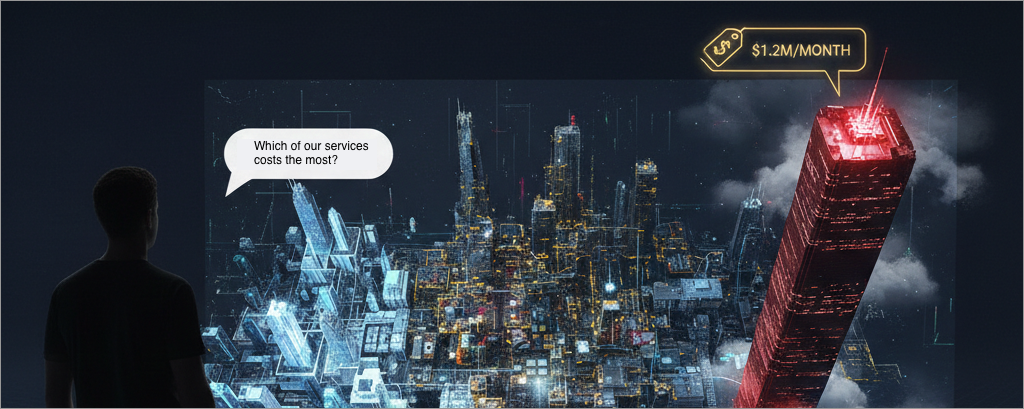
A Manager asks about cost:
"Why is the 'Billing' skyscraper so tall?"
The AI guide responds, not with a data table, but with a narrative grounded in the visual model:
"The 'Billing' service is our most expensive service due to its high memory requirements and the large team assigned to it. Its height reflects a monthly cloud spend of $50,000 and a personnel cost of $120,000. The building is also glowing brightly, indicating it's processing a high volume of transactions, which contributes to its cost."
An Architect asks about risk:
"Which buildings have the most 'decay' and are also on a major 'highway'?"
The AI guide highlights several crumbling buildings along the brightest, most active data pathways in the city:
"I've highlighted three services with significant technical debt that are also on your critical path. The 'Legacy-Auth' service, in particular, has not been updated in two years but handles 40% of all user login traffic. It presents a significant risk."
An Engineer asks about dependencies:
"I need to deprecate the v1 'Product-Info' API. Show me what will break."
Instead of just a list, the city visualizes the blast radius. The specific API endpoint on the building darkens, and all the "streets" leading out from it to other buildings begin to flash red.
"Deprecating this API will directly impact 12 other services, including the 'Mobile-Gateway' and the 'Web-Frontend'. I can show you the specific teams that own those services and the exact code locations where the API is being called."
The Power of "Why?"
A simple chat interface can answer "what" questions. But a conversational guide integrated with a spatial model can answer "why" questions. It can reason about the relationships between different dimensions of the city.
- "Why is the 'Search' district experiencing so much 'decay'?"
- "The services in this district have a high rate of team turnover, leading to a loss of institutional knowledge. The buildings here are old, and records show three separate attempts to refactor them were started but never completed."
- "We had an outage last night. Show me what happened."
- The guide can initiate a visual replay, showing a 'power surge' of traffic hitting one building, which then 'browns out' and causes a cascading 'blackout' in the buildings connected to it. "The outage originated in the 'Cache' service, which received an unexpected spike in traffic, leading to connection pool exhaustion that cascaded to its downstream dependencies."
An Interface for Everyone
This is the ultimate democratization of architectural knowledge. Product managers, executives, and support engineers don't need to learn how to read complex diagrams or use developer-specific tools. They can simply ask the questions they already have, in their own language.
The architect, the engineer, and the manager from our story can now all stand around the same holographic city, ask their own questions, and get answers that are not only accurate but also make sense in a shared, visual context.
The Software City, when combined with a conversational AI, becomes more than a visualization. It becomes a sentient partner in understanding and building our digital world. It's a future where our systems can finally explain themselves.